CW-10201   Click here for help

GtoPdb Ligand ID: 14665

Compound class: Synthetic organic
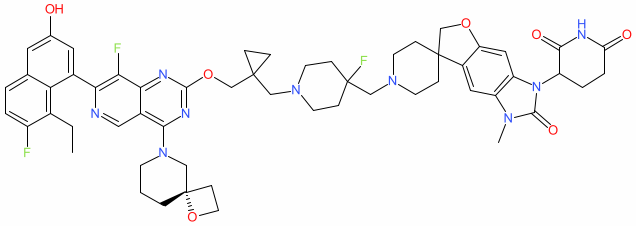
Comment: CW-10201 is a PROTAC degrader for oncogenic KRAS proteins with G12V/D mutations [1]. It engages the cereblon E3 ligase (CRBN) using the novel high-sffinity, tetracyclic ligand AA-17010 to promote KRAS ubiquitination and proteasomal degradation. KRAS binding is mediated by a derivative of the non-covalent KRASG12D inhibitor MRTX1133.
2D Structure
Click here for help
Click here for structure editor
Physico-chemical Properties
Click here for help
Hydrogen bond acceptors 16
Hydrogen bond donors 2
Rotatable bonds 11
Topological polar surface area 164.44
Molecular weight 1030.14
XLogP 3.01
No. Lipinski's rules broken 3

Generated using the Chemistry Development Kit (CDK) (Willighagen EL et al. Journal of Cheminformatics vol. 9:33. 2017, doi:10.1186/s13321-017-0220-4; https://cdk.github.io/)

SMILES / InChI / InChIKey
Click here for help
Canonical SMILES CCC1=C(C=CC2=CC(=CC(=C21)C3=NC=C4C(=C3F)N=C(N=C4N5CCC[C@]6(CCO6)C5)OCC7(CC7)CN8CCC(CC8)(CN9CCC%10(CC9)COC%11=C%10C=C%12C(=C%11)N(C%13CCC(=O)NC%13=O)C(=O)N%12C)F)O)F
Isomeric SMILES FC1=C(C2=CC(O)=CC3=CC=C(F)C(CC)=C32)N=CC4=C(N5CCC[C@]6(CCO6)C5)N=C(OCC7(CC7)CN8CCC(CN9CCC%10(CC9)COC%11=CC%12=C(N(C)C(N%12C%13CCC(NC%13=O)=O)=O)C=C%11%10)(F)CC8)N=C41
InChI InChI=1S/C56H62F3N9O7/c1-3-35-39(57)6-5-33-23-34(69)24-36(45(33)35)47-46(58)48-37(27-60-47)49(67-17-4-9-56(30-67)16-22-75-56)63-51(62-48)74-31-53(10-11-53)28-65-20-14-55(59,15-21-65)29-66-18-12-54(13-19-66)32-73-43-26-42-41(25-38(43)54)64(2)52(72)68(42)40-7-8-44(70)61-50(40)71/h5-6,23-27,40,69H,3-4,7-22,28-32H2,1-2H3,(H,61,70,71)/t40?,56-/m0/s1
InChI Key WOHUMPUYAKVSDD-DSLDWSAXSA-N

Generated using the Chemistry Development Kit (CDK) (Willighagen EL et al. Journal of Cheminformatics vol. 9:33. 2017, doi:10.1186/s13321-017-0220-4; https://cdk.github.io/)

References
1. Wang C, Ghosh P, Jin S, Bai L, Aguilar A, McEachern D, Wang M, Li Q, Wen B, Sun D et al.. (2026)
Discovery of Highly Efficacious CRBN-Based KRAS Degraders Targeting Cancers with KRAS G12D and G12V Mutations.
J Med Chem, Online ahead of print. DOI: 10.1021/acs.jmedchem.6c01153